Short answer
Most people have never watched a bathroom come down to the studs and go back up, so the process can feel like a black box. Knowing the order of the work tells you which decisions are due when, and makes it easier to spot a contractor cutting a corner.
1. Decide the scope and the layout
Start with what the room needs to do, then decide between three kinds of project: a cosmetic refresh (paint, lighting, vanity, fixtures), a tub-to-shower conversion, or a full remodel down to the studs. Then decide whether the toilet, shower and vanity stay where they are. Keeping the plumbing in place is the biggest single lever on cost, because moving a drain means opening the floor and, in New Jersey, a plumbing permit.
2. Choose every product before demolition
Tile, vanity, top, faucets, shower valve and trim, toilet, lighting, fan, glass and hardware. Every product still undecided when the walls come down is a reason for the crew to stop and wait. Special-order tile, custom vanities and measured glass have the longest lead times, so pick those first.
3. Get it in a written contract
New Jersey requires the contract to describe the work and the principal products, with make, model and size where they apply, and to state the total price, the start and completion dates, and any warranty (N.J.A.C. 13:45A-16.2). Read what a New Jersey contract must include before you sign.
4. Permits
Some bathroom work is ordinary maintenance under the Uniform Construction Code and needs no permit: replacing faucets, shower valves and traps, swapping a fixture for a similar one without changing the piping, replacing flooring, cabinets and bathroom accessories, and like-for-like light fixtures (N.J.A.C. 5:23-2.7). Moving or adding drain, waste, vent or supply piping, new wiring, and cutting a load-bearing wall all need a construction permit (N.J.A.C. 5:23-2.14). A full remodel almost always needs one.
A contractor may not start until the permits are issued (N.J.A.C. 13:45A-16.2). More detail: when a New Jersey remodel needs a permit.
5. Demolition, and what is behind the walls
Demolition is fast and it is where surprises surface: water damage behind the tub surround, soft subfloor around the toilet, old supply lines, wiring that has to be brought up to date. Older houses hide more, so a good quote says how that work will be priced if it turns up. In a home built before 1978, paid work that disturbs paint falls under the EPA's lead-safe rules; see lead paint rules for older homes.
6. Rough-in
The plumbing, electrical and framing that end up inside the walls and floor:
- Plumbing: supply and drain lines, the shower valve, tub filler, toilet flange and vanity connections.
- Electrical: outlets, lighting, the exhaust fan and any heated-floor circuit.
- Ventilation: a bathroom needs either windows with at least 3 square feet of glass, half of it openable, or artificial light and an exhaust fan vented directly outdoors (IRC 2021 NJ Edition, R303.3).
- Framing and blocking: niches, a bench, and solid backing for grab bars, a floating vanity and glass panels.
7. Inspections
On a permitted job in a one- or two-family home, work stops until each required inspection is made, including the mid-point inspections of framing, rough plumbing and rough electrical (N.J.A.C. 5:23-2.18). That is why nobody should close a wall before the inspector has seen it.
8. Waterproofing and backer board
Wet areas get cement or foam backer board and a waterproofing membrane before any tile goes on. It is invisible on the day the bathroom is finished and decides whether the shower is still sound years later. Ask each contractor which system they use and how the shower pan is built.
9. Tile
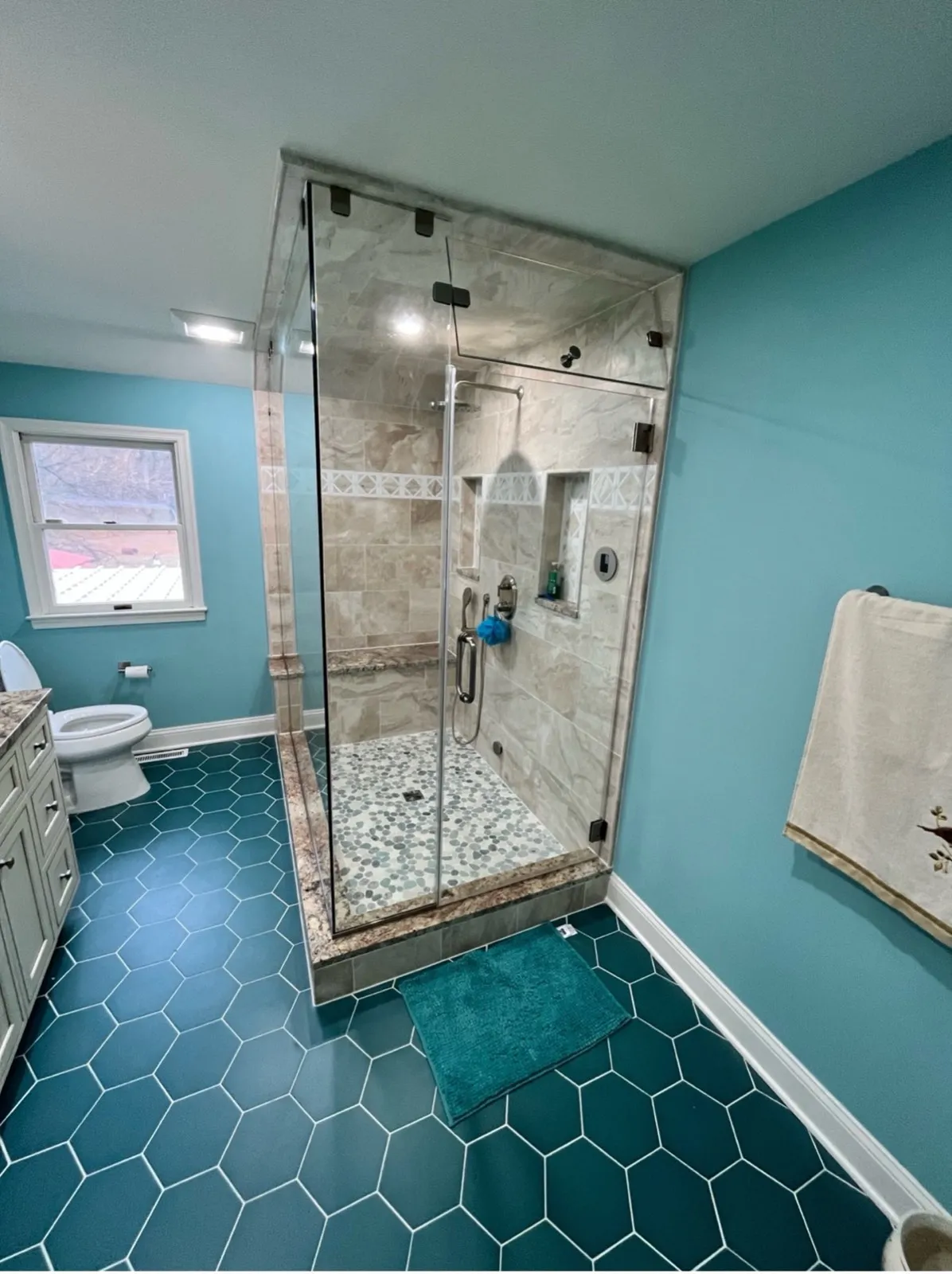
The slowest and most skill-dependent step: floor, shower walls, niches and any wainscot, then grout and sealing. Grout and thinset need cure time, so tile cannot be rushed. The vanity, trim and lighting usually go in alongside.
10. Fixtures, glass, final inspection and punch list
Toilet, faucets and shower trim are set and tested, the glass is measured after the tile and installed, then the mirror and hardware. The final inspections come next. Where inspections are required, the contractor must give you copies of the inspection certificates before final payment is due, and may not ask for final payment before the work is complete (N.J.A.C. 13:45A-16.2). Walk the room with the contractor and list anything that is not right: caulk lines, paint touch-ups, a door that rubs.
How long it takes
Timelines vary with the scope, the house and how long selections and permits take. For a national benchmark, primary bathroom projects averaged 8.4 months of planning and 4.8 months of construction among U.S. homeowners who renovated in 2025, according to the 2026 U.S. Houzz & Home Study. Those averages include do-it-yourself work. Planning taking longer than building is normal, and it is where a project's budget is won or lost. Whatever the length, New Jersey requires a home improvement contract to state the dates or time period for starting and finishing the work (N.J.A.C. 13:45A-16.2).
If this is your only bathroom, plan where the household will shower while the room is out of service, and ask when the water will be shut off.
Mistakes to avoid
- Choosing tile after demolition starts. Lead times stall the job.
- Moving plumbing for looks alone. Sometimes it is worth it. Get both layouts priced before deciding.
- Skipping the fan. A bathroom without a window needs an exhaust fan vented outdoors, and one with a small window still benefits from it.
- Hiring on price alone. A quote far below the others usually leaves out waterproofing, permits or the repairs behind the walls. See how to choose a contractor in New Jersey.
What it costs
Nationally, a major primary bath remodel had a median cost of $18,000 for primary baths under 100 square feet and $30,000 for larger ones in 2025, and the median spend on any guest bathroom renovation, from a refresh up, was $7,000 (2026 U.S. Houzz & Home Study). The full breakdown, with how home age differs across South Jersey towns, is in the bathroom remodel cost guide.
Start with a walkthrough
We look at the plumbing, the layout and the structure, talk through what you want, and follow up with a written quote. Estimates are free. Request a bathroom estimate, call (856) 214-9156, or see our bathroom remodeling page.
Sources
- Houzz Inc., 2026 U.S. Houzz & Home Study (renovation spend and project length in 2025). Checked September 2026.
- New Jersey Uniform Construction Code, N.J.A.C. 5:23-2.7, Ordinary maintenance (work that needs no permit). Checked September 2026.
- New Jersey Uniform Construction Code, N.J.A.C. 5:23-2.14, Construction permits: when required. Checked September 2026.
- New Jersey Uniform Construction Code, N.J.A.C. 5:23-2.18, Inspections (work stops for each required inspection; performed within three business days of a request). Checked September 2026.
- New Jersey Division of Consumer Affairs, N.J.A.C. 13:45A-16.2, Home Improvement Practices (contract terms, permits, warranties). Checked September 2026.
- International Code Council / N.J. Uniform Construction Code, International Residential Code 2021, New Jersey Edition: R303.3 bathroom ventilation, R305 ceiling height, R310 emergency escape and rescue openings. Checked September 2026.
- U.S. Environmental Protection Agency, Lead Renovation, Repair and Painting Program Rules, 40 CFR 745 Subpart E. Checked September 2026.