Short answer
How long it takes
Timelines vary with the scope, the house and how long selections and permits take. For a national benchmark, kitchen projects averaged 9.5 months of planning and 5.8 months of construction among U.S. homeowners who renovated in 2025, according to the 2026 U.S. Houzz & Home Study. Those averages include do-it-yourself work. Planning taking longer than building is normal, and it is where a project's budget is won or lost. Whatever the length, New Jersey requires a home improvement contract to state the dates or time period for starting and finishing the work (N.J.A.C. 13:45A-16.2).
1. Set the budget and the scope
Decide what kind of project this is before designing anything. Nationally, the median spend on any kitchen renovation in 2025, from a refresh up, was $24,000, while a major remodel, with at least all cabinets and appliances replaced, had a median cost of $35,000 for kitchens under 200 square feet and $55,000 for larger ones (2026 U.S. Houzz & Home Study). Keep a contingency for what turns up behind the walls, especially in an older house. The full breakdown is in the kitchen remodel cost guide.
2. Settle the layout
Keeping the sink, range and refrigerator where they are keeps plumbing, gas and venting where they are, which keeps cost and permits down. Moving them, opening a wall or adding an island with a sink is often worth it, but it is a structural and mechanical project, not just a cabinet swap. Price both layouts before deciding.
3. Choose everything, cabinets and appliances first
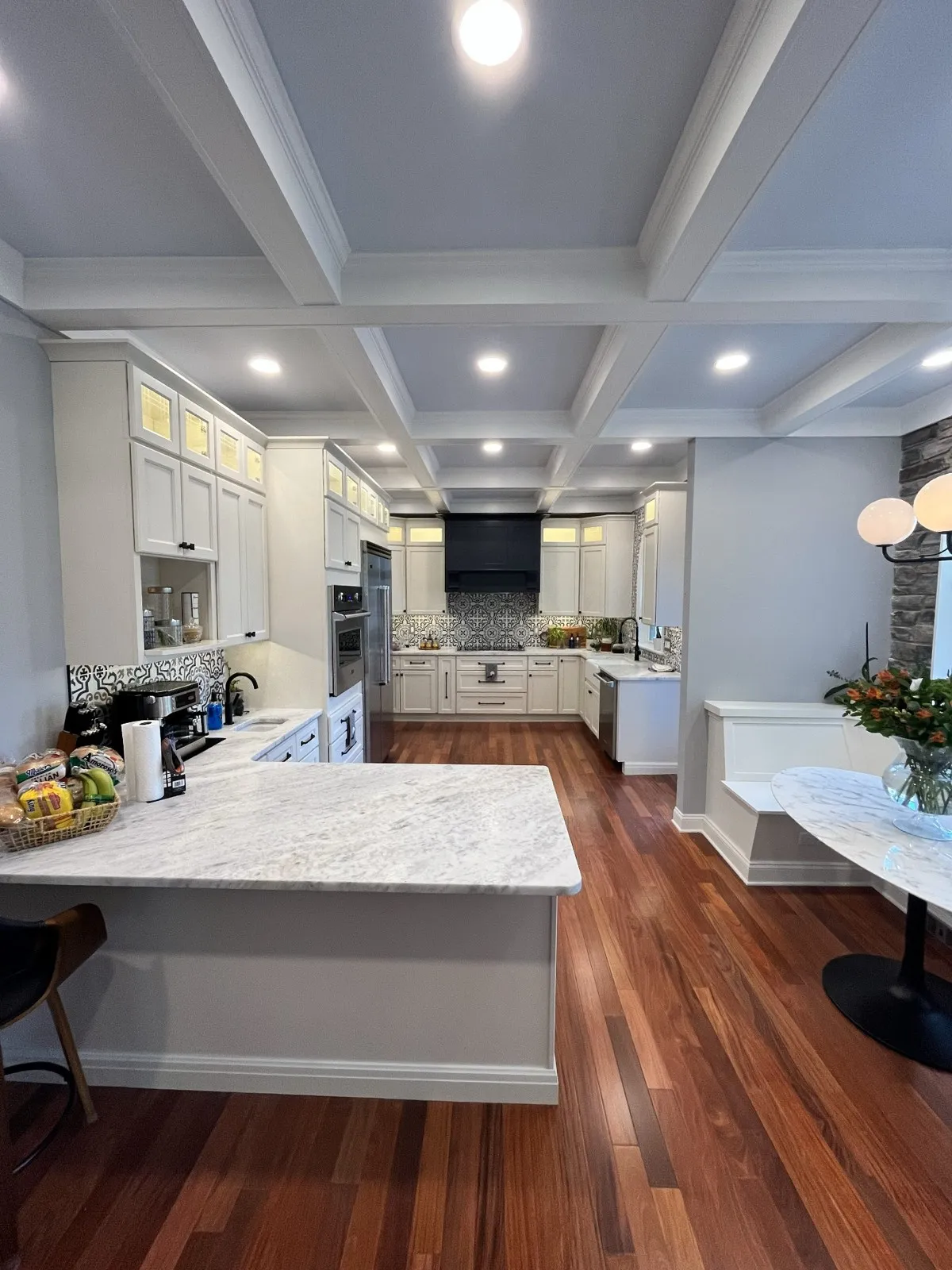
Cabinets and appliances decide the rest: cabinet sizes depend on appliance specifications, and they are usually the longest lead times in the job. Then tile, flooring, sink and faucet, lighting and hardware. Countertops are chosen now but measured later, from the installed base cabinets. It is usually wise not to start demolition until the cabinets are delivered, so a shipping delay does not leave you without a kitchen.
4. Put it in a written contract
New Jersey requires the contract to name the principal products, with make, model and size where they apply, and to state the total price, the start and completion dates and any warranty (N.J.A.C. 13:45A-16.2). Any change to the dates has to be agreed in writing. See what a New Jersey contract must include.
5. Permits
A kitchen that keeps its layout can be mostly ordinary maintenance: new cabinets, flooring, trim, paint, a like-for-like light fixture, a new dishwasher, and a range hood that exhausts no more than the old one or 400 cubic feet per minute (N.J.A.C. 5:23-2.7). Moving the sink, running or moving a gas line, adding circuits or cutting a load-bearing wall needs a construction permit (N.J.A.C. 5:23-2.14), and the contractor may not start that work until the permit is issued (N.J.A.C. 13:45A-16.2). More: when a New Jersey remodel needs a permit.
6. Demolition
The floors from the door to the kitchen get protected and the openings sealed against dust, then cabinets, counters and appliances come out and walls open where the plan needs them. In a home built before 1978, paid work that disturbs paint follows the EPA's lead-safe rules (what they require).
7. Rough-in and inspections
New plumbing, gas, circuits, lighting and ventilation go in while the walls are open. On a permitted job in a one- or two-family home, work stops until each required inspection is made, including the mid-point inspections of framing, rough plumbing and rough electrical (N.J.A.C. 5:23-2.18).
8. Walls, floors and cabinets
Insulation and drywall close the walls, then flooring (often before cabinets, so it runs under them) and the cabinet installation: bases leveled, uppers hung, fillers and trim fitted.
9. Countertops, backsplash and finish
The countertop fabricator templates the installed base cabinets, then cuts and installs the tops. The backsplash follows, then the sink, faucet, appliances, lighting and hardware. Final inspections come last. Where inspections are required, the contractor must give you copies of the inspection certificates before final payment is due (N.J.A.C. 13:45A-16.2).
10. Punch list
Walk the kitchen with the contractor and list everything that is not right: a door that does not close square, a scratch, a caulk line, a drawer that sticks. Final payment follows a finished punch list.
Living without a kitchen
- Set up a temporary kitchen in another room: the refrigerator if it can move, a microwave, a coffee maker and a folding table.
- Plan meals around the gap between cabinet installation and countertops.
- Keep a clear path from the door to the kitchen for the crew and deliveries.
- Ask when the water, gas and power will be shut off, and for how long.
Start with a walkthrough
We look at the room, the structure and the utilities, talk through how you cook and live, and price the kitchen you want. Estimates are free. Request a kitchen estimate, call (856) 214-9156, or see our kitchen remodeling page.
Sources
- Houzz Inc., 2026 U.S. Houzz & Home Study (renovation spend and project length in 2025). Checked September 2026.
- New Jersey Uniform Construction Code, N.J.A.C. 5:23-2.7, Ordinary maintenance (work that needs no permit). Checked September 2026.
- New Jersey Uniform Construction Code, N.J.A.C. 5:23-2.14, Construction permits: when required. Checked September 2026.
- New Jersey Uniform Construction Code, N.J.A.C. 5:23-2.18, Inspections (work stops for each required inspection; performed within three business days of a request). Checked September 2026.
- New Jersey Division of Consumer Affairs, N.J.A.C. 13:45A-16.2, Home Improvement Practices (contract terms, permits, warranties). Checked September 2026.
- U.S. Environmental Protection Agency, Lead Renovation, Repair and Painting Program Rules, 40 CFR 745 Subpart E. Checked September 2026.